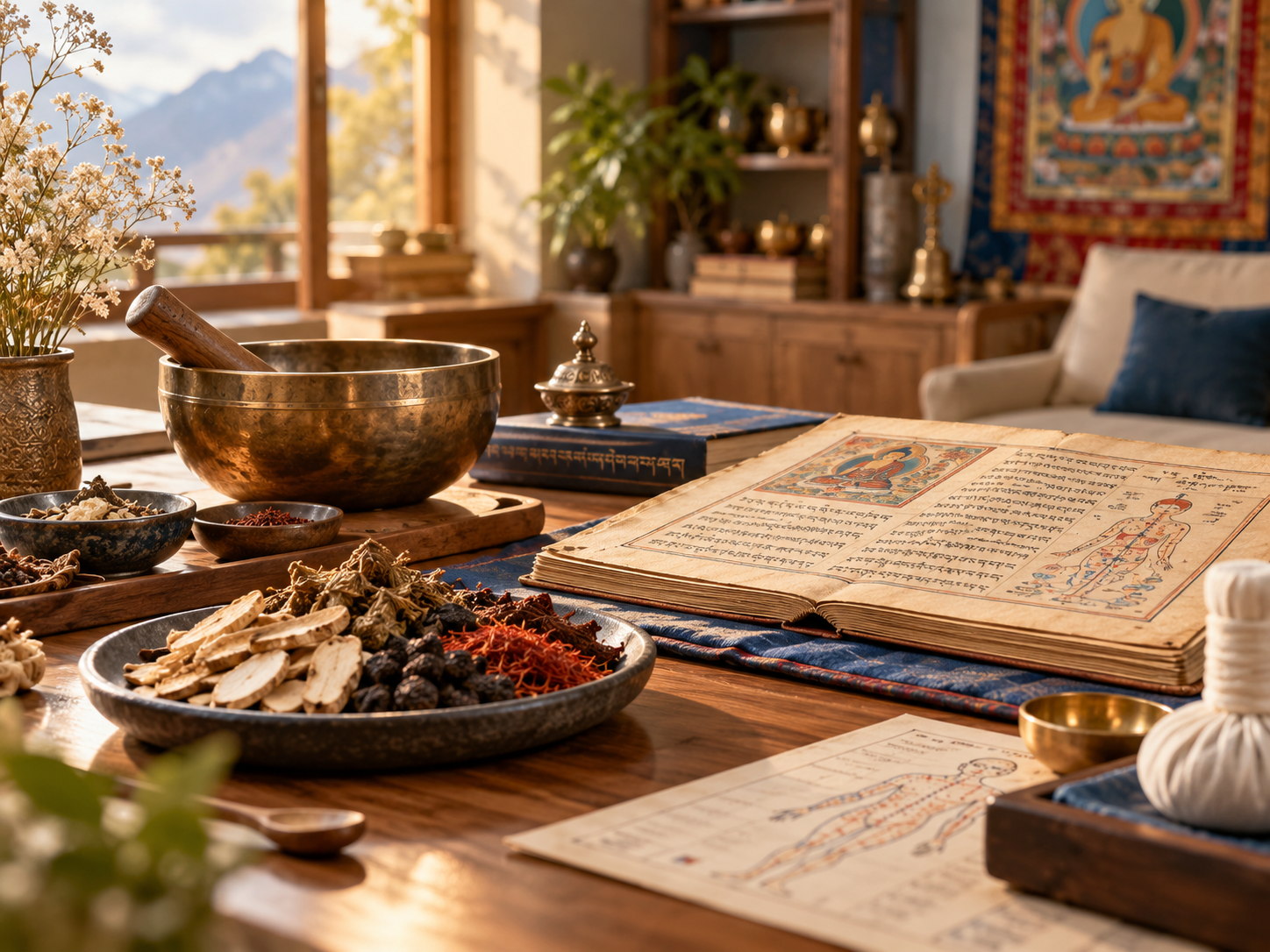
Preserving tradition
Tibetan Medicine
Holistic. Individual. Contemporary.
Seeing body, energy and mind as an interconnected whole.
___
FOUNDATIONS
A holistic system with its own diagnostics, constitutional theory and therapy.
Tibetan Medicine views health as a dynamic balance of body, energy and mind. At its core are the individual constitution, lifestyle and the question of how internal and external influences affect this balance.
THE THREE ENERGIES
Lung · Tripa · Beken – understanding the individual constitution.
Tibetan Medicine describes Lung, Tripa and Beken as three fundamental functional principles that influence physical processes, energy, metabolism and mind. Their individual balance shapes a person’s constitution and plays a central role in understanding how health is maintained and how imbalances arise.

Lung (Wind)
Movement, breathing, the nervous system, sensory activity and mental dynamics.

Tripa (Bile)
Heat, digestion, metabolism, clarity and purposeful action.

Beken (Phlegm)
Stability, structure, regeneration, calm and physical substance.
TRADITION
Tradition and Transmission
Knowledge carried across generations.
Tibetan Medicine – Sowa Rigpa, the “Science of Healing” – developed over centuries from Tibetan healing traditions and influences from India, China, Persia and Central Asia. Its classical foundation is formed by the Four Medical Tantras, supplemented by extensive commentaries and medical teaching texts. To this day, the five elements and the three functional principles Lung, Tripa and Beken remain at the heart of this system.
For many centuries, Tibetan Medicine evolved in a cultural and technological environment very different from that of today. Diagnostic knowledge was transmitted personally – within families, from teacher to student and within monastic Buddhist traditions. Much of this medicine was based on direct experience, observation, decades of practice and very close personal transmission.
Pulse diagnosis in particular illustrates both the strength and the limitation of this system: mastering it with confidence can require decades of intensive experience. This knowledge cannot be reproduced or scaled at will and is therefore available only to a limited extent for broader medical care today.
MODERN COMPLEMENT
Our approach is therefore not to replace this tradition, but to make it accessible under today’s conditions. Modern measurement methods, laboratory analyses and technical diagnostics can complement areas that previously relied exclusively on personal experience. They help to objectify findings, make them reproducible and make knowledge easier to transfer.
Tradition remains the foundation.
Modern methods help us make it more reliable and more widely applicable today.
HOLISTIC APPROACH
FROM DIAGNOSIS TO HEALING
Modern diagnostics – traditional therapeutic logic.
The modern complement to our diagnostics does not change the fundamental perspective of Tibetan Medicine. Rather, it helps us assess conditions, changes and imbalances more reliably and document them in a transparent and reproducible way.
The therapeutic interpretation that follows continues to be based on the classical principles of Tibetan Medicine: the individual constitution, the balance of Lung, Tripa and Beken, the five elements, and the interaction of nutrition, lifestyle, herbal medicine and external therapies.
In treatment as well, we combine this traditional foundation with selected modern methods. Where they provide a meaningful complement, modern physical therapies, laboratory findings, micronutrients or technical applications can be integrated into the individual treatment concept.
What matters is not whether a method is old or modern.
What matters is that it integrates meaningfully into the Tibetan understanding
of health, imbalance and regulation.
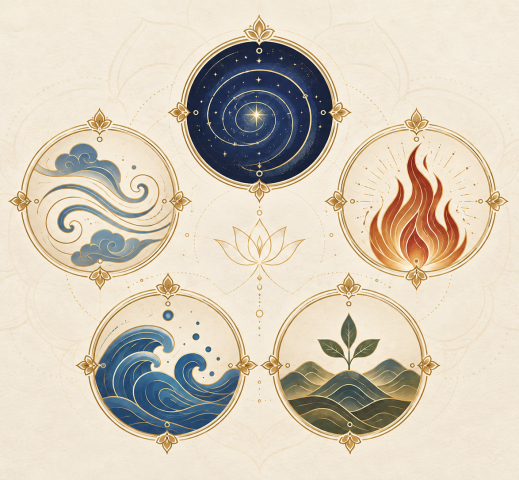
THE FIVE ELEMENTS
The foundation of body, energy and environment.
In Tibetan Medicine, space, air, fire, water and earth form the fundamental principles underlying all physical and mental processes. Lung, Tripa and Beken also arise from different combinations of these elements. Health is therefore not understood as a fixed state of balance, but as an individual and constantly changing equilibrium.
SPACE · AIR · FIRE · WATER · EARTH
OUR NAME
Panchasana – the five elements as our foundation
The name Panchasana brings together two levels of meaning: “Pancha” comes from Sanskrit and means “five”. “Sana” is directly associated in the field of health with health, healing and regeneration.
For us, Panchasana therefore stands for the five elements – space, air, fire, water and earth – and for the aim of supporting their individual balance.
In this way, the name already reflects the core of our medical understanding: health arises from the interaction of fundamental forces and their harmonious regulation.
Would you like to discover how Tibetan Medicine can be applied today?
We combine traditional principles with modern diagnostics and contemporary therapeutic methods.
PANCHASANA®
CENTRE FOR MODERN TIBETAN MEDICINE
“Health is the harmony of
body, mind and environment.”